
 At the beginning of the twenty-second chapter of his novel Howard’s End, E. M. Forster includes in the narration of the mind of Margaret Schlegel, one of the story’s heroines, a passage that has for decades been one of the most inspirational and guiding of my life, “Only connect! That was the whole of her sermon. Only connect the prose and the passion, and both will be exalted, and human love will be seen at its height.” Not surprisingly, when I find a book that seeks to connect “the prose and the passion” – which so often in my reading can be interpreted as the sciences and the humanities – I take it up with particular interest and enthusiasm.
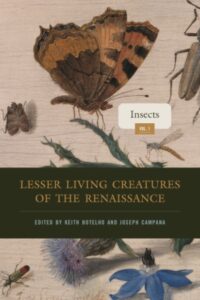
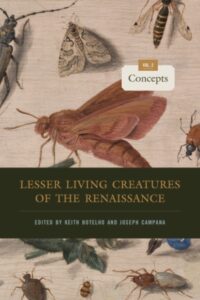
Recently, I took up not just a single book but a brace of them: Lesser Living Creatures of the Renaissance; Volume 1, Insects, and Volume 2, Concepts. Published as a set by Penn State University Press as part of their Animalibus: Of Animals and Cultures series, this delightful and superbly informative pair of books are both edited by Keith Botelho and Joseph Campana and feature the work of over a dozen literary scholars with particular interests in the representations and roles of animals in human society.
 In Volume 1, Insects, which uses “insects” in an admittedly expansive and literary sense that well fits the historical period examined much more appropriately than it does our own, each chapter takes a particular insect, arachnid, and even worm as its topic, From silkworms, ants and fleas, through flies, gnats, maggots, bees, wasps, and others, through to waterbugs, worms, and scorpions, the author of each chapter examines aspects of what role the creatures in question played in society during the period, what social, literary, or political associations they may have had, and how they were depicted.
Volume 2; Concepts then revisits many of these creatures not in themselves but in things, activities, actions, or structures associated with them. Such things as stings, scales (for those unfamiliar (butterflies and moths are lepidopterans – “scale wings”), venom, swarms, pests, decomposition, and so forth are all subjects of chapters in this volume.
As someone who nourishes active interests in both the arts and the sciences, particularly natural philosophy, and the literature and history of early modern England, I could scarcely believe my good fortune to have been made aware of these two books. If you are similarly of a broad and enquiring mind, I very much recommend that you consider adding these to your own reading list as well, and if you aren’t, then I recommend them even more so in the hope that you too will begin to heed Miss Schlegel’s excellent advice.
If you enjoyed reading this, please consider signing up for The Well-read Naturalist's newsletter. You'll receive a helpful list of recently published reviews, short essays, and notes about books in your e-mail inbox once each fortnight.
