
In 1964, U.S. Supreme Court decided the case Jacobellis v. Ohio, involving whether the state government of Ohio could ban the showing of the Louis Malle film The Lovers (Les Amants), which the state had deemed to be obscene. In deciding the case, Justice Potter Stewart (now) famously declared, “”I shall not today attempt further to define the kinds of material I understand to be embraced within that shorthand description [i.e., “hard-core pornography”]; and perhaps I could never succeed in intelligibly doing so. But I know it when I see it, and the motion picture involved in this case is not that.” This “I know it when I see it,” founded as it is in a person’s belief and trust in his or her own common sense, was already a long and widely applied standard of judgement before Justice Stewart penned it into his opinion in this case, and it has in recent years become an even more widespread method of judgement across a vast range of subjects with widely varying levels of appropriateness.
The problem – well, one of many – is that when applied to scientific fields, such as astrobiology, it is woefully insufficient to the task. Should we humans ever attain a level of technology that enables us to reach deep enough into space so as to collect and analyze sufficient information – be it visual or audio signals, or even physical samples from another planet – that will require us seriously to face the question “Is this life?” it is much more likely than not that we will, in fact, not know it when we see it; at least not by any method that could be applied as “common sense.” Unlike what has so often been presented in science fiction and science fantasy books and films, the first signs of extraterrestrial life we encounter will quite likely not be humanoid. It may very well not fit entirely – or perhaps even at all – into our present biological taxonomy. It may not even still be alive as it may be found in the form of a fossil, or perhaps a trace fossil, or a chemical signature.
The universe is presently calculated to be somewhere in the neighborhood of fourteen billion years old. It is very possible that in that time, as entire star systems have come and gone, so a given form of life may well have also done so. Perhaps, alternately, the first signs of extraterrestrial life that comes to our attention may be of a form that is just coming into existence. Such things are well beyond our human common sense to perceive; the totality of our Earth-bound, temporally constrained existence precludes such methods of thinking. However, that does not mean that we cannot undertake activities here on Earth, as well as learning from other activities already being undertaken for different purposes, to reconfigure our thought processes in order to prepare them for what may one day be discovered.
In his newly published book The Pale Blue Data Point; An Earth-Based Perspective on the Search for Alien Life, Dr. Jon Willis, professor of physics and astronomy at the University of Victoria, takes his readers along on his journeys – both physical and intellectual – in search of new methods of enquiry and new paradigms of thought that may be applicable to the recent, growing, and very interesting field of study known as astrobiology. From his expeditions to the bottom of the northeastern Pacific, to the far western shores and deserts of Australia, and high into the mountains of Chile, Prof. Willis considers and very clearly explains some of the possibilities of what might someday be found on other planets, planetoids, and other celestial objects, and how present research into such fields as biology, chemistry, paleontology, and Earth science here on this planet could play a significant role in how we can identify past or present life on others.
As with his previous published book All These Worlds Are Yours; The Scientific Search for Alien Life, for which Prof. Willis borrowed his title from the very famous line in Arthur C. Clarke’s science fiction novel 2010: Odyssey Two, in which the computer HAL begins repeatedly broadcasting the message “ALL THESE WORLDS ARE YOURS – EXCEPT EUROPA. ATTEMPT NO LANDING THERE.” [sic], so he also offers an homage to another very famous book – science fact rather than fiction this time – in the title of this present one: Dr. Carl Sagan’s Pale Blue Dot: A Vision of the Human Future in Space.
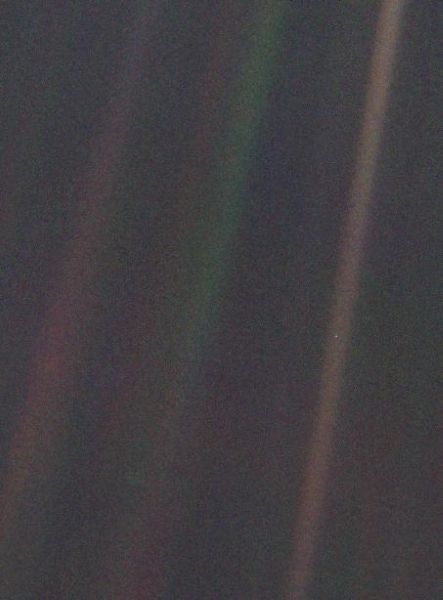
Dr. Carl Sagan, inspired by an image that was taken, at his own suggestion as a “parting shot,” if you will, by Voyager 1 on 14 February 1990 when it was approximately 6.4 billion kilometers away from Earth and bound for the fringes of the solar system, that showed our home planet as a tiny bluish speck surrounded by the vastness of space, wrote in his book:
Look again at that dot. That’s here. That’s home. That’s us. On it everyone you love, everyone you know, everyone you ever heard of, every human being who ever was, lived out their lives. The aggregate of our joy and suffering, thousands of confident religions, ideologies, and economic doctrines, every hunter and forager, every hero and coward, every creator and destroyer of civilization, every king and peasant, every young couple in love, every mother and father, hopeful child, inventor and explorer, every teacher of morals, every corrupt politician, every “superstar,” every “supreme leader,” every saint and sinner in the history of our species lived there–on a mote of dust suspended in a sunbeam.
Given the contents of Prof. Willis’ new book, the title was a superb choice. It at once encapsulates the limitations of our present existential knowledge given our position here on Earth while at the same time offering even that limited perspective as a valid source of information – a data point – in the developing field of study into the existence of life beyond our own home planet.
The book is – as the kids these days say – a winner right from the start. Having already piqued my interest with what he presented in his delightfully clear and engaging writing style in the opening chapter that is named for the title of the book itself, given my life-long interest in marine biology, Prof. Willis thoroughly captured and held my attention with his second one, “Twenty Thousand Pings Under the Sea; In Search of Alien Oceans.” In this marvelous, lively, and knowledge-expanding chapter – which well sets the tone and level for the rest of the book – Prof. Willis recounts his adventures with the team of the E/V Nautilus as they explored sites at the bottom of the Pacific Ocean, discovering new, fascinating, and indeed other-worldly geological, chemical, and biological phenomena. Somewhat ironically, given the admonishment conveyed in the original source of the title of his first book, it is just such research at the bottom of the seas that will be of particular use in developing experiments applicable to exploration of two of the most likely sites of existing life in Earth’s own solar system: the ice covered Saturnian moon Enceladus and the also ice encased, likely oceanic Jovian moon Europa.
From the end of that chapter it’s then off to the Australian western shores and the western Australian desert to explore and consider stromatolites, as well as macro- and microscopic fossils. From these, Prof. Willis links explorations and ideas into the potential for previous life on the planet Mars. Following this, it’s up into the mountains of Chile for a visit to La Scilla Observatory and an explanation of technologies used to map the observable skies using techniques to analyze information from both within and beyond the human visual spectrum. After this, meteorites are considered in what they contain and may have long ago contained that perhaps sparked the beginning of the process that has led to our own existence here on Earth.
Finally, in his concluding chapter “So Long and Thanks for All the Fish; A Dolphin-Led Guide to Alien Communication” – another literary allusion, this time to Douglas Adams’ fourth book in his series The Hitchhiker’s Guide to the Galaxy – Prof. Willis considers the possibilities of communication by other forms of life through research that has been performed with one of our fellow Earthling species that has for decades been thought to have complex systems of communication carried on in a form that our own senses can, at least somewhat, perceive. My eyes opened particularly wide when I discovered that none other than Dr. John Lilly – an author whose books on the subjects cetacean biology and communication that I had read with great interest back in my own university days and that was responsible for significantly broadening my own mind to the possibilities of there being more things in Heaven and Earth than were at that time dreamt of in my own young and limited philosophies – had played a significant role in early astrobiological studies, including S.E.T.I., and who would also play a prominent role in the chapter.
Likely needless to state at this point, I found Prof. Willis’ The Pale Blue Data Point absolutely riveting. Not only did I find it difficult to put down, I often continued my reading of it (rather than turning to the work of fiction I keep beside my bed and reserve for the purpose of bed-time reading) just before turning in to sleep for the night; something I make a practice of not ordinarily doing with books I’m reading for review. I simply didn’t want to stop reading it as each page contained a new (to me, at least) piece of information or a new (also to me) way of understanding something I perhaps already did know.
If you have an interest in astrobiology, astronomy, biology, Earth science, or simply enjoy reading a book that will cause you to say “Wow!” with great regularity whilst reading it, I very much encourage you to read The Pale Blue Data Point for yourself. After having done so, I very much doubt that you’ll ever look up into the night sky ever again and not find your mind filled with new questions, curiosities, and dreams of what may one day be found on one of those glittering – perhaps red, perhaps green, perhaps even blue – dots.
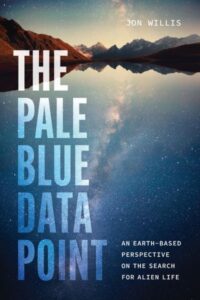 Title: The Pale Blue Data Point; An Earth-Based Perspective on the Search for Alien Life
Authors: Prof. Jon Willis
Publisher: University of Chicago Press
Format: Jacketed Hardcover
ISBN: 9780226822402
Pages: 256 pages w/ 10 color plates and 10 halftones
Date of Publication: October 2025
In accordance with Federal Trade Commission 16 CFR Part 255, it is disclosed that the copy of the book read in order to produce this review was provided gratis to the reviewer by the publisher.
If you enjoyed reading this, please consider signing up for The Well-read Naturalist's newsletter. You'll receive a helpful list of recently published reviews, short essays, and notes about books in your e-mail inbox once each fortnight.
