
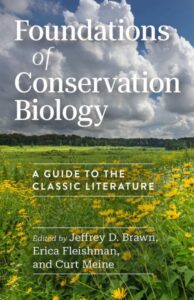
 I’ve long followed the maxim “you’ll never know where you’re going if you don’t know where you’ve been.” It’s been a guidepost for me in more or less everything I’ve ever set out to learn. And as Prof. Jeffrey D. Brawn, Dr. Erica Fleishman, and Prof. Curt Meine, editors of the new Foundations of Conservation Biology; A Guide to the Classic Literature clearly demonstrate in their creation and organization of the book, it’s a maxim that they very much believe to be one worthy of following as well.
Beginning right off with the biggest of the biggies, Alexander von Humboldt’s ground-breaking Cosmos, then continuing with summaries and explanations of the importance of other foundational works that inspired the development of the field itself as well as those who created it, furthered it, and right on up to those just entering it today, this is a book that quickly makes clear it’s importance to any and all who seek to understand the field as it began, as it progressed, changed, and where it is headed in the future.
I would say that this is a book from which one could fill tablets with notes, but in truth, taking such notes is really not necessary as the entire book itself is a well-filled notebook ready and waiting to be consulted for book recommendations, points of historical context, insights into the philosophies that undergird the field, and most any other purpose for which a note might commonly be made.
If you enjoyed reading this, please consider signing up for The Well-read Naturalist's newsletter. You'll receive a helpful list of recently published reviews, short essays, and notes about books in your e-mail inbox once each fortnight.
