Aristotle. The very name itself conjures images of the prototype for all philosophers. Yet was he really the philosopher he is so commonly thought to have been or was he, in fact, the first systematic scientist?
The Lagoon

This category contains full-length reviews of, short essays about, and new pertaining to books.
Aristotle. The very name itself conjures images of the prototype for all philosophers. Yet was he really the philosopher he is so commonly thought to have been or was he, in fact, the first systematic scientist?
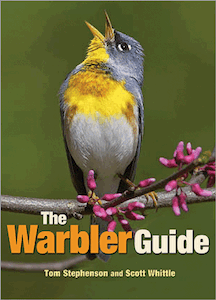
When it comes to bird families whose members are tricky to learn to identify, gulls and warblers would likely be near the top of most any bird watcher’s list. However while gulls do present the challenges of multi-year plumage cycles and frequent identity-confounding hybridizations, they are fairly large, often lethargic birds that can commonly be approached and observed for lengthy periods of time. Warblers, on the other hand, are very small feathered darts that even when they do perch to glean are rarely stationary for more than a second or two. Yet while a number of books have been published on learning to identify gulls, warblers have generally been treated as simply another family to puzzle out like the rest included in field guides.
When Charles Bowden’s Killing the Hidden Waters was first published in 1977, the population of Arizona – the U.S. state in which he was then living and part of the region in which so much of his narrative takes place – was a little under two-and-a-half million people. In 2003, the year in which his new introduction “What I Learned Watching the Wells Go Down” was added to the fifth paperback printing of the book, the state’s population had risen to over five million. Most who read it thought it both inspired and brilliant, but according to his opening words in the new introduction, he “went wrong.”