
Just about anyone can, with enough money and a basic familiarity with the major optic brands, pick out a good binocular. The trick is picking not just a good binocular but picking the best one for you for what you intend to do with it – and if the best one for what you intend to do with it is not the one likely, for one reason or another, to appeal to the largest number of potential buyers, chances are the advertising dollars needed to bring it to your attention might not be spent on it.
Therefor, in the great Well-read Naturalist tradition of finding and publicizing not necessarily what is popular but what we have found to possess particular merit, the following binoculars – all of which we have used extensively in the field – are put forward as being models that should not be overlooked by those seeking a field optic best suited to their specific requirements and preferences. All binocular models presented here are arranged in alphabetical order by brand. This is “live” overview and will be updated from time to time as appropriate.
—–
The Bushnell Elite e2 7x26mm
Best uses: bird watching, travel, general purpose

While it may look much like many other compact inverted Porro prism binocular models on the market today, the Bushnell Elite e2 7x26mm is actually far above its look-alikes in both construction and performance. One need only take one of these little gems in hand to tell that something about it is unlike most other compact inverted Porro models. While not heavy by any means, it feels sturdy and possessed of the solidity denoting a well-made instrument.
Containing some of the largest Porro prisms to be found in any compact inverted Porro model presently in production, the Elite e2 7x26mm offers its user a visual image that is not only richly dimensional but exceptionally expansive in depth of field for a compact binocular; something particularly valuable in any field optic intended for general and therefore multi-faceted use.
(Regular readers might recall that in the past The Well-read Naturalist has not commented favorably on the use of compact binoculars for extensive field use; which is why it should be considered as a sign of just how impressed we are with this particular binocular that we would break with this general outlook and unreservedly recommend it for such use.)
—–
The Kowa YF30-6 6x30mm
Best uses: bird watching, family outings, general purpose
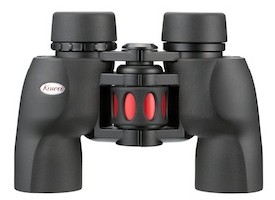 Designed to be the definitive universal binocular (it is equally suitable for use by children as it is by adults), the Kowa YF30-6 6x30mm brings the classic field glass pairing of 6x magnification and 30mm objective lenses to a contemporary optics-using audience who is daily barraged by the generally inappropriate message “bigger is better.” Needless to say, bigger is not always better; in fact, bigger is usually a problem – for field of view, for brightness of image, and for stability.
There’s a reason so many naturalists have been able to accomplish so much with 6x30mm Porro prism binoculars; they offer a wide field of view, a generous depth of field (to enable the user to perceive well into both the fore and backgrounds of the object being viewed), an image that is bright and clear, and they can easily be held steady with one hand. Sadly, in the quest for higher magnification and close “near focus” distances, the simplicity and effectiveness of the classic 6x30mm format has been all but forgotten; which is why Kowa is to be so heartily commended for keeping it available to contemporary naturalists.
—–
The Pentax Papilio 6.5x21mm
Best uses: butterfly watching, entomology, botany, geology
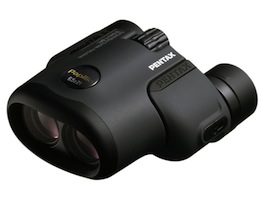 Although it may seem contradictory to praise one compact inverted Porro prism binocular for its stout solidity and then laud another that is widely noted for its lightness of weight, it must be kept in mind that much of what makes any one model of field equipment, including optics, excel in relation others is the effectiveness with which it fulfills the purpose for which it was designed. In the case of the Pentax Papilio 6.5x21mm, the purpose for which it was designed is the viewing of butterflies and the effectiveness with which it accomplishes this, thanks in large part to its design, is truly remarkable.
Employing a patented convergent lens system in combination with an inverted Porro prism design, the Papilio is designed to allow it’s user to focus on an object that is as close as 18 inches from its objective lenses without rendering the image as divided. Ordinarily such close distances require the use of a single optical channel (monocular) macroscope. As might be expected, the emphasis on such a remarkable near focus capability renders the Papilio a bit less than ideal for distance observation; however this should be of little consequence to those who understand and value it for what it does do better than any other binocular on the market today – allow very close-up observation of very small subjects.
—–
The Swarovski Habicht 8x30mm
Best uses: bird watching, general purpose
 “Pure class;” that’s the best way to describe the Swarovski Habicht 8x30mm. Possessing all the quality one would expect from an optical instrument bearing the Swarovski name, this eminently classic, leather wrapped 8x30mm Porro prism binocular brings to mind the classic field glasses toted to the ends of the Earth by the great naturalists.
Make no mistake; this is not by any means a purely utilitarian binocular. It is not armored nor is it officially water-proof (although the one we have has been used under most all conditions and not once has it shown itself to be anything less than fully up to the task at hand). It is, however, possessed of the necessary prisms and lenses to provide its user with one of the richest, most astonishingly dimensional true-to-life images to be found in any binocular on the market today. Even more, and perhaps not of particular importance to all but to those for whom it is, it is sublime, the exterior design and trim of the Habicht 8x30mm is of such a form as to be both inviting and delightful to the touch. This is a binocular that one simply must hold in one’s hands; it settles comfortably into one’s palms and the fingers naturally flow around its graceful curves in a way that cannot be matched by any other binocular presently in production.
Unfortunately, as with so many things today that put timeless quality ahead of passing styles, the Habicht 8x30mm is not an easy binocular to obtain. While still produced by Swarovski Optik, it is generally only found for sale in Europe but can apparently be obtained in North America though a special order placed with an authorized Swarovski dealer.