
With the exception of most domestic dogs I’ve had the pleasure of meeting, I find no non-human animal to be more charismatic than the eight (perhaps nine; more on that to come) extant species of pangolin. To me, these fascinating gentle creatures that peacefully go about their business clad in a complete suit of scales far exceed the appeal of all the usual animals commonly cited in such a category. Not pandas, lovable goofy stoners though they be, not elephants, majestic in size and presenting a mien of sublime wisdom, not tigers, burning bright, not wolves in all their mysterious and mythological glory; none exceed the pangolins when it comes to capturing and holding my attention. For those who might not have ever seen a pangolin, either in life or on film, I would direct you to this lovely visual aid produced by BBC Earth and narrated by – who else? – Sir David.
So when I was made aware that pangolins are now extensively the victims of a vast and thriving international – and highly illegal – trafficking trade by Timothy Bonebrake’s recently published book Crime and Pangolins; A Mammalian Murder Mystery, I was rendered both enraged and heart-broken. Who could possibly be so cruel as to hunt down and kill an animal that posses no threat to any other creature larger than the insects that comprise its diet and whose sole means of defense is to curl up into a scale-covered ball? Hunting them isn’t even hunting; gathering potatoes presents more of a challenge than collecting up these peaceable pholidotids when rolled up in their protective- so they thought – keratin-encased balls.
The story recounted by Prof. Bonebrake, director and professor of the School of Biological Sciences at The University of Hong Kong. in this book is indeed a murder mystery, with all the twists and turns of the best in that classic genre. Sadly, the story he recounts in presenting the state of pangolins in the modern world is all too true crime. It all begins with the interception by the authorities in Hong Kong of a smuggled shipment of eighty-eight dead pangolins in 2018. Given the condition of the earthly remains of these most unfortunate creatures – bludgeoned, gutted, and denuded of scales – answers to such questions as who killed them, who transported them, where were they headed, to what purpose were their bodies to be put, why were their scales removed and where had they gone, and who was behind and benefiting from this wasteful atrocity all demanded answers.
Being granted the seized shipment in order to attempt to learn more about these eighty-eight pangolins and how they came to be frozen and sealed in bags in Hong Kong, Prof. Bonebrake and his team set to work. It was to be work that would not only take them into the little understood life biology of these remarkable animals but across continents in search of answers to questions the implications of which turned out to be more complex than were previously imagined.
There are presently eight extant species of pangolins known today, and a possibly ninth (Manis mysteria) and tenth (Manis aurita) one as well which have not been observed in the wild as genetic examinations of pangolin remains have recently disclosed. All eight that have been observed in the field are listed as critically endangered, endangered, or vulnerable, and all eight are actively trafficked. With ranges variously spanning from western central Africa to southeast Asia, as Prof. Bonebrake explains, pangolins are hunted for bushmeat that is primarily sold in markets near where they are killed, and trafficked for “status food” and for Chinese traditional medicine (TCM). In this some of the challenges to their conservation begin to show themselves.
As Prof. Bonebrake so compellingly explains, pangolins hunted and sold for bushmeat in African village markets are an important source of protein for those who eat them. The argument that such easy-to-capture edible animals should not be dietary options for those existing in far more precarious economic circumstances than the researchers, wildlife conservation agents, and others from more economically developed countries is a difficult one to defend. However as the African pangolin species so hunted there are also the source of pangolin scales trafficked into Asia for use in TCM, the matter becomes more complex.
But there is also hunting and trafficking for both consumption in Asia, but this is less commonly part of a bushmeat trade. Asian species are more likely to be destined either for sale into higher end markets or restaurants and consumed as a status symbol meat. They are also often trafficked into the supply chains of TCM practitioners – particularly their scales – for use in alleviating such conditions as malaria and deafness, promoting lactation, and even dispelling evil spirits. And while the Chinese government removed pangolin body parts from the official Chinese Pharmacopeia, they are still widely in demand by practitioners and patients alike to a sufficient degree that they are worth the risks of being caught trafficking them.
Like so many subjects of illegal international trafficking, pangolins – either whole bodies or dried scales – are not necessarily the primary items in the trafficking networks through which they are moved. This makes them part of larger and much more dangerous transactions involving larger and more dangerous organizations, which makes, as Prof. Bonebrake recounts, uncovering the logistics of their transit so challenging.
Then, of course, as this story began in 2018 and unfolded across the global COVID-19 pandemic, given the fact that pangolins are sold in “wet” markets in China, they were commonly cited in reports as the possible source of transmission for the SARS-CoV-2 virus. Thus as would be expected, Prof. Bonebrake explores this line of enquiry at some length.
At this point it should be sufficiently established that Crime and Pangolins is a book well worth the attention and reading time of all those with an interest in endangered animals, wildlife conservation, and the tricky and delicate questions of balancing the needs and traditions of human cultures against the well-being of non-human species. Give the attention Prof. Bonebrake gives to the COVID-19 pandemic and it’s possible zoonotic vector, it is also a book that should be of interest to those who study the history of modern medicine, public health, and epidemiology. Then, of course, as it is a well-written, compelling account of the search for the answer or answers to a mystery, it could well satisfy all those who enjoy a jolly good one filled with twists, turns, and an international cast of interesting characters. If you found yourself in any of the categories I’ve just listed, or if something else in this essay has piqued your interest, I hope you will act accordingly and seek out a copy to read for yourself.
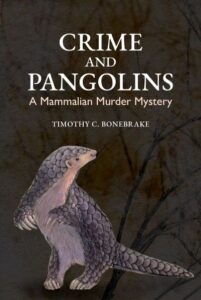 Title: Crime and Pangolins; A Mammalian Murder Mystery
Author: Timothy C. Bonebrake
Publisher: University of Hong Kong Press
Distributor: University of Chicago Press
Format: paperback
Pages: 184, with 15 half-tones
ISBN: 9789888900985
Date of Publication: April 2026
In accordance with Federal Trade Commission 16 CFR Part 255, it is disclosed that the copy of the book read in order to produce this review was provided gratis to the reviewer by the publisher, according to standard practice in book reviewing.
If you enjoyed reading this, please consider signing up for The Well-read Naturalist's newsletter. You'll receive a helpful list of recently published reviews, short essays, and notes about books in your e-mail inbox once each fortnight.
