
 As a life-long tea drinker (and yes, I am entitled to declare that without hyperbole as my grandmother put it in my bottle when I was a baby in order to give me taste for it early and prevent me from becoming a coffee drinker as my father had converted my mother to be) I’ve long been interested in the different flavours and qualities of its many varieties and blends. Occasionally I will also venture outside of the traditional Camellia sinensis teas and brew a pot of something for medicinal use, such as nettle or fennel tea. As a result of all this tea drinking, I’ve by now assumed that I was fairly well versed in tea, but thanks to an episode of The History of Plants podcast, I learned of a new one that sounded so intriguing that I was moved to seek it out and try it: yaupon holly tea.
For those who are not familiar with yaupon holly tea, it is brewed from the extraordinarily unfortunately named plant Ilex vomitoria, the naming of which is one of the main stories recounted by Megan Brame in the podcast previously referenced. Native to southeastern North America, this caffeine-producing plant has for centuries been brewed by a number of First Nations peoples for its uplifting effects. It was also used by some in the United States once that nation had been established during times when coffee and tea were not available due to wars, embargoes, and other human foolishness.
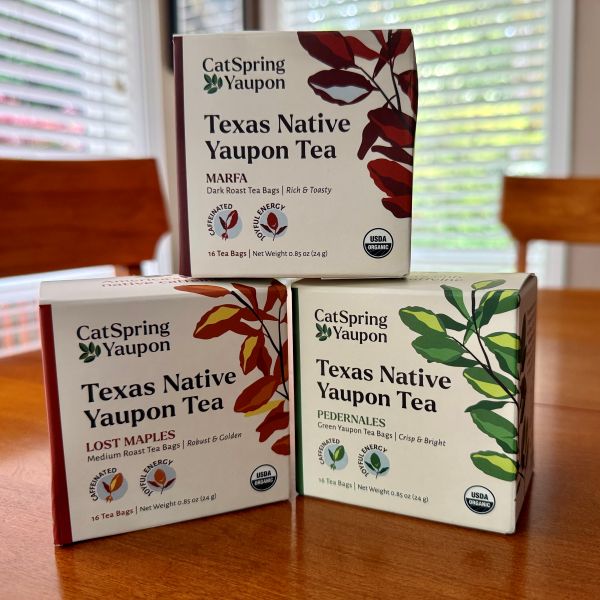
Listening to Ms. Brame’s tales of its history, effects, and taste, I found myself very keen to try yaupon tea for myself, so I did a bit of searching and found Cat Spring Yaupon, a Texas-based purveyor of this unjustly overlooked tea. I purchased one of their three blend sample packs (note – “I purchased” – I’m not some smarmy”influencer” always cadging for items to be given to them in exchange for attention; in truth the people of Cat Spring Tea don’t even know who I am) and eagerly broke into the boxes promptly upon their arrival. I selected the medium strength Lost Maples blend as my inaugural taste and brewed a cup.
Having no expectations beyond Ms. Brame’s description of yaupon tea as somewhat like strong black tea with a hint of sweetness, I was genuinely delighted with the flavour. To me, it is reminiscent of the roasted barley in genmaicha tea, but with a slightly brighter overall taste. It is also a bit dryer than, say, the caramel – liquory flavour of an oolong or even a Darjeeling. And as for the effect, it clearly has a respectable amount of caffeine, but that is balanced by other components in it that take away the direct punch common with coffee and bring it closer to the full body lift of a bold black camellia tea yet with a touch more emphasis on the head to yield a sharper mental focus. Indeed, I was able to accomplish quite a lot of detailed analytical work that afternoon without at any time feeling jittery (as with coffee) or a bit too relaxed (as my beloved oolongs often make me).
So there it is – a natural history podcast episode about the history of plants yielding me not only new and interesting knowledge but also a new type of tea for my tea cabinet. I’ll most certainly be enjoying a nice cup of yaupon with regularity form now on, and I’ll be looking forward to future episodes of The History of Plants for more delightfully cross-over discoveries.
If you enjoyed reading this, please consider signing up for The Well-read Naturalist's newsletter. You'll receive a helpful list of recently published reviews, short essays, and notes about books in your e-mail inbox once each fortnight.
