
When I first took up birdwatching, any mention I heard, any reference I read, any non-verbal cue I perceived regarding the European Starling (Sturnus vulgaris) – at least when in regard to their existence in North America – was universally negative. “Trash birds!” was a common epithet. “Ought to be exterminated” and “invasive” were two other frequently heard or read comments. No one ever had a good word to say about these highly vocal, seemingly numerous, feisty, black, sometimes iridescent, sometimes bespeckled little birds. Some birdwatchers – more the point, birders – I knew seemed reluctant even to note them down in their lists, as if the simple act of doing so would somehow taint all the other birds included.
Of course, when I began to meet more birdwatchers and other naturalists from Europe and elsewhere around the world, the opinion changed quite noticeably. My new-found British acquaintances seemed to like them, finding them interesting and very much worthy of study. There were also heard to be mentions of grand areal displays by large flocks called “murmurations” that were described in terms such as “magical” and “hypnotic.” Were these the same birds? How could a bird so witheringly despised on one continent be the subject of fascination on another? Weren’t all birds worthy of attention and study by all birdwatchers? Slowly as my knowledge of birds began to enlarge, I came to understand that the European Starling was not a naturally occurring bird in North America but one that had been transported to the continent from Europe and intentionally introduced in the late nineteenth century in New York City with consequences that were much less than desirable to some other North American bird species. But was such an introduction truly so horrible? After all, the Ring-necked Pheasant (Phasianus colchicus) was also introduced from China into Oregon at approximately the same time and people seem to love them.
Naturally, the devil, so the saying goes, is in the details. All bird species are different, and how one species artificially introduced into a new area will effect the ecosystem – if it even survives – will be very different from how another may do so. In the case of the European Starling, the story is anything but a straight-forward one, and it is filled with a variety of characters, purposes, and events every bit as colorful as the metallic sheen on their feathers, and it is compellingly recounted by Mike Stark in his book Starlings; the Curious Odyssey of a Most Hated Bird.
Those who count themselves amongst the field glass, notebook, and field guide toting tribe have likely at some time in the past heard something about this fellow in New York City who released a number of European Starlings there because of something to do with Shakespeare. Mr. Stark almost immediately sets the record straight in this. Yes, there were a number of European Starlings released in New York’s Central Park on Tuesday, 23 April 1889 – seventy-two birds, to be exact. They were purchased, imported, and released by Mr. Eugene Schieffelin, a sixty-two-year-old wealthy attorney and businessman. He released another batch in 1890, and a third batch in 1891. Why did he do this? Edwin Way Teale wrote in 1947 that it was because Mr. Schieffelin intended to introduce all the birds mentioned anywhere in the plays and poems of William Shakespeare. The problem is that there is no record from Mr. Schieffelin himself regarding any such intention. But this is by no means the most significant part of the story.
The United States of the nineteenth century was rife with introductions of plant and animal species from far off lands. From the European Starlings to Ring-necked Pheasants previously mentioned to European Goldfinches, Crested Mynas, Eastern Grey Squirrels, English Ivy, House Sparrows, Golden Bamboo, Kudzu, Water Hyacinth – all found new homes in the U.S. during this period (for those interested in this subject, Kim Todd did a superb job of presenting the whats and whys of such introductions in her award-winning book Tinkering With Eden: A Natural History of Exotic Species in America, Norton 2001, now out of print). Why were they brought to America? Each case is different, but most of the cases can be classed into one of two basic reasons: pest control (House Sparrows, for example) or the desire for decoration (Eastern Grey Squirrels, Golden Bamboo, and English Ivy, for example).
The exact reason for the introduction of the European Starling isn’t entirely clear. Their effectiveness in controlling agriculturally pestiferous insects wasn’t known at the time, and the Shakespeare story is apparently a latter-day creation. As many other birds that were introduced from Europe and Asia – with the exception of such species as pheasants and partridges that were imported and released for hunting purposes – were brought to the U.S. for the purpose of enlarging the variety of birdsong to be heard in cities and towns, the European Starlings, highly vocal as well as remarkable mimics likely can be grouped with these.
While many of the bird species introduced during this period quickly died off, some never even surviving long enough to breed with their fellow travelers, the European Starling overcame the odds and not only survived but thrived in their new continental home. Remarkably catholic in their diet, gregarious, and highly adaptable, the newly arrived birds made it clear that they were not only here to stay but to proliferate and expand their range, eventually from coast to coast and into Canada as well. This is where Mr. Stark’s research and story-telling skills really take flight.
As the European Starling population increased and expanded in range, people began to discover that they were not always desirable as neighbors. Colonies could become large – quite large – resulting in troublesome levels of both noise and feces. America being what it is, quick thinking entrepreneurs and hucksters alike (often, as is still frequently the case embodied in a single individual) stepped in with claims to near-magical abilities to remove unwanted populations of the newly arrived birds. While some met with temporary success, as Mr. Stark recounts, such victories were much more often than not short-lived.
Naturally, as time passed, ornithologists and ecologists began to understand more about the European Starling and as a result discover that its presence was not entirely wholly destructive. Their aforementioned wide-ranging diet includes a range of agriculture-damaging insects as well as a respectable list of cottage garden pests. However this must also be balanced with the fact that a large flock can also inflict significant crop damage themselves. And while they also consume insects that plague livestock – particularly cattle – they do so in a way that can injure the livestock in the process and even instill fear in domestic herds of the birds themselves.
Then, of course, there is the matter of airplanes. On 4 October 1960, an Eastern Airlines Lockheed Electra, flight 375, collided with a flock of European Starlings just after take-off from Boston Logan with sixty-two people dying as a result of the crash. It remains the largest loss of human life in an aircraft bird strike incident. I won’t spoil the story by disclosing the reason it happened but this story in and of itself is well worth the price of the book. I will say, however, that largely because of this event, designers of airplanes and airports, as well as aviation managers, both civilian and military, all around the world have expended significant time and capital to reduce the number of and potential damage from aircraft bird collisions.
I could easily continue but I would rather hope that what I have already written is sufficient to cause you to seek out a copy of the book for yourself to discover all that it has to teach about the truly interesting, multi-faceted, and perspective-expanding story about the arrival and proliferation of the European Starling in North America. If you come to a reading of it hating them, you may find yourself doing so even more, but you also may find that you actually have developed a new-found respect for them. If you come to it with a fondness for them, you may discover that perhaps they are not quite so worthy of affection as you previously thought, but then you may find that your admire them even more. It’s that sort of book, and I very much hope that you will enjoy reading it and find in it as much useful as well as interesting information as I did.
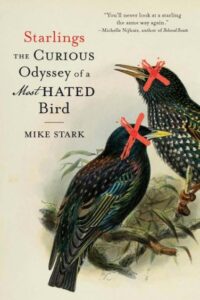 Title: Starlings; the Curious Odyssey of a Most Hated Bird
Author: Mike Stark
Publisher: University of Nebraska Press
Imprint: Bison Books
Format: Paperback
Pages: 272 pp., 11 photographs, 7 illustrations
ISBN: 9781496242020
Published: March 2025
In accordance with Federal Trade Commission 16 CFR Part 255, it is disclosed that the copies of the books read in order to produce this review was provided gratis to the reviewer by the publisher.
If you enjoyed reading this, please consider signing up for The Well-read Naturalist's newsletter. You'll receive a helpful list of recently published reviews, short essays, and notes about books in your e-mail inbox once each fortnight.
