
The legacy of the late eighteenth, early nineteenth century polymath Alexander von Humboldt is as extraordinary as the life he lived. Natural philosopher, world traveler, explorer, mountain climber, geographer, social and political thinker, von Humboldt packed so much into his eighty-nine years of existence on our planet that in reading his biography it is sometimes difficult to believe that such a person actually existed. Yet despite the number and far-reaching results of his accomplishments, amongst which may be counted proposing a holistic method of studying the natural world that would one day become ecology and laying the foundations for James Lovelock’s Gaia Hypothesis, the prolific level of writing he maintained throughout his adult life, and the number of naturalists, scientists, philosophers, and other noteworthy thinkers who cite him as an inspiration, he is far more readily known today by what has been named in his honor than by what he actually said and wrote.
 Von Humboldt’s name has been bestowed on numerous plant and animal species (such as Spheniscus humboldti, the Humboldt Penguin, and Lilium humboldtii, Humboldt’s Lily), geographical features (such as Humboldt Bay and the Humboldt Current), cities, towns and parks (such as Hacienda Humboldt, Chihuahua, Mexico, Humboldt, South Dakota, United States, and the Alexander von Humboldt National Forest, Peru), astronomical objects (such as Mare Humboldtianum on Earth’s moon and 4877 Humboldt, an asteroid), the mineral humboldtine, institutions of higher learning (Humboldt University of Berlin and Universidad Alejandro de Humboldt in Caracas, Venezuela), lectures, awards, ships, and works literature and music. Chances are that if any given person has heard his name, it is because one of these myriad eponymous honorifics.
His books, on the other hand, are now not well known even to many who consider themselves learned in the history of natural history or the many subjects they treat, and fewer still have actually read any of them. It has now come to the point where if one lacks German as a fluent language, even obtaining a complete copy of most of the books he wrote in translation is difficult. His most famous five volume series of books, Cosmos; A Sketch of a Physical Description of the Universe, is only presently available in English in volume one from Johns Hopkins University Press. Thanks to the Alexander Humboldt in English Project, four critical edition volumes, including his Views of the Cordilleras and Monuments of the Indigenous Peoples of the Americas, are also available from University of Chicago Press. After these, an abridged edition of his Personal Narrative of a Journey to the Equinoctial Regions of the New Continent is included in the Penguin Classics series, and a collection of his writings, being largely portions of the books just mentioned, in the Everyman’s Library series, and that’s it.
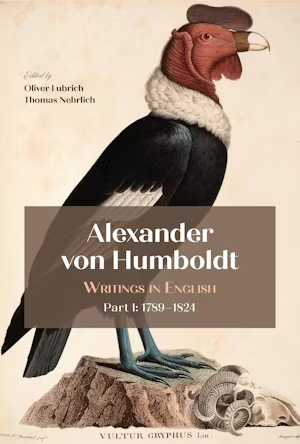
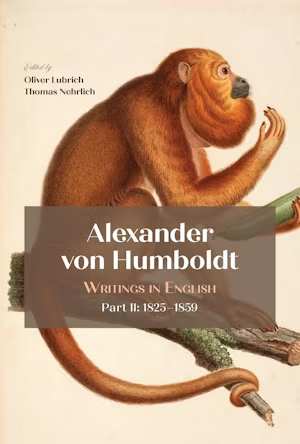 Or at least is was until the publication this year by the American Philosophical Society Press of a remarkable two volume set of his writings in English. Published in two large volumes – Alexander von Humboldt: Writings in English, Part I: 1789–1824 and Alexander von Humboldt: Writings in English, Part II: 1825–1859 – both edited by Oliver Lubrich and Thomas Nehrlich, this new collection of von Humboldt’s essays, articles, reviews, public letters and many other forms of non-book writings makes available to the interested reading public not only a vastly expanded and accessible body of work that was previously difficult to find, it presents his published work in the forms in which it was much more likely to have been read by those who did so during his lifetime.
As anyone who has read – or at least tried to read, even his expansive Cosmos (which reported to have originally been titled Gaea) will attest, while it is enlightening, it is not by any means light reading. And while it was very popular in the nineteenth century, it was still not readily accessible to many. Yet it was still far more so than another of his more well known books, the Views of the Cordilleras, which only saw six hundred volumes originally published in its fully illustrated and quite expensive glory. However his non-book writings, published as they were in newspapers and other periodicals, were how most people during his lifetime and throughout the nineteenth twentieth centuries came to know him for the genius that he was, and it is two-hundred-fifty of these very works that are contained in this new two volume set.
Presenting works spanning the expansive range of von Humboldt’s interests, from natural philosophy to studies of geography and peoples to politics and religion, the writings in Alexander von Humboldt: Writings in English invite the reader into the myriad chambers of the author’s mind, providing the opportunity not only to discover what he thought but to explore his life. Having never written an autobiography – perhaps one of the few genres of writing in which he didn’t engage, he is remembered as declaring that those interested should seek for his life in his works. And as this collection of writings includes journals, reports, and reflections upon the places he visited, the things he saw there, and the ideas that emerged from these experiences, the impressionistic portrait of von Humboldt to be gained from this pair of books is a vivid one indeed.
To all interested in the history of natural history, the history of science, any of the many subjects upon which von Humboldt wrote, or who simply would like to enjoy a lively and diverse collection of writings that will assuredly open the mind to new ideas, new perspectives, and narratives of grand adventures, these books are most heartily recommended.
Title: Alexander von Humboldt: Writings in English, Part I: 1789–1824 and Alexander von Humboldt: Writings in English, Part II: 1825–1859
Author: Alexander von Humboldt
Editors: Oliver Lubrich and Thomas Nehrlich
Publisher: The American Philosophical Society Press
Distributor: University of Pennsylvania Press
Format: Jacketed Hardcover (electronic editions also available)
Pages: Volume 1: 760 pp., Volume 2: 680
Publication Date: August 2025
ISBN: Volume 1: 9781606180167, Volume 2: 9781606180181
In accordance with Federal Trade Commission 16 CFR Part 255, it is disclosed that the copies of the books read in order to produce this review was provided gratis to the reviewer by the publisher.
If you enjoyed reading this, please consider signing up for The Well-read Naturalist's newsletter. You'll receive a helpful list of recently published reviews, short essays, and notes about books in your e-mail inbox once each fortnight.
