
 Having been raised on the north Oregon coast in a town that had fishing at both its cultural and economic heart in a family of commercial fisherman and cannery women who had been so since first coming to America from Finland before Finland was Finland, I have lived my life with a particular awareness of and interest in – both from a natural history as well as a culinary perspective – the creatures of the rivers and seas.
Not surprisingly, given the fact that the Dungeness Crab (Metacarcinus magister) is at the heart of one of the most economically important seafood industries in the area, it was and remains at the heart of my family’s winter holiday traditions. Every year, come the end of November, the forecast for and opening of the crabbing season becomes a daily subject of monitoring and discussion amongst all living along the coast as well as those of us who did and are still within driving distance of the coastal fish markets.
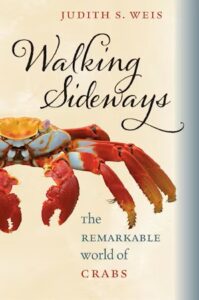
Yet recently I realized that while I had quite a respectable amount of knowledge about the Dungeness as a species, at least as was relevant to the fishery of it, I didn’t really know all that much about the natural history of crabs in general. Therefore I went in search of a source with which to correct my ignorance about the lives and biology of these creatures in their remarkable 7,000 plus species diversity. What I found was Prof. Judith S. Weis‘ 2012 book Walking Sideways; The Remarkable World of Crabs.
In this very readable and particularly informative presentation of the biology and lives of the true crabs, Prof. Weis guides her readers through explanations of crab evolution and classification, habitats, unique adaptations to water and land, reproduction and development, behavior, ecology, and threats to their populations. Not surprisingly, she also includes information about crab fisheries and aquaculture, crabs as food, and crabs in literary and popular culture. She also provides answers to a number of common popular questions often asked about crabs – such as their relationship to lobsters – and presents information about recent developments in research about crabs – including the use of Horseshoe Crabs (which despite their common name are not crabs at all but chelicerates and more closely related to arachnids) in medical research.
Reading Walking Sideways was a truly delightful experience. Not only did it provide me with a wealth of new knowledge about crabs but it also provided me with the opportunity to correct things that I have long thought to be correct about them but that were either partially or wholly incorrect. It is in this latter that I take particular enjoyment from a book. Learning something new is always a joy, but correcting what I thought I knew about a subject and replacing it with correct information is one of the great pleasures of my life’s journey as both an autodidact and a naturalist.
Whether your interest in crabs is specific to them, part of a larger interest in marine life or ecosystems, or commercial or culinary in nature, I heartily encourage you to find and read a copy of Walking Sideways to expand the body of knowledge you bring to whatever your particular interest that includes them may be.
If you enjoyed reading this, please consider signing up for The Well-read Naturalist's newsletter. You'll receive a helpful list of recently published reviews, short essays, and notes about books in your e-mail inbox once each fortnight.
