
 In North America and increasingly in Europe as well, the full moon in the month of August is often referred to as the Sturgeon Moon. The name is widely reported to have originated from the month being an opportune time to fish for sturgeon in the Great Lakes. However according to the Royal Museums Greenwich, this same moon is also called the Green Corn Moon, the Grain Moon, and “the Red Moon for the reddish hue it often takes on in the summer haze.” However for my part, I prefer the Celtic name: the Lynx Moon.
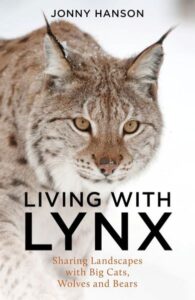
For many, associating anything with a Lynx may seem a bit difficult – so few living people have ever seen one in the wild, much less lived with them as a part of their lives. Dr. Jonny Hanson, a noted authority on Snow Leopard conservation, however, is very familiar with Lynx in the wild, as well as a number of other large carnivores. He has studied their relationship to ecosystems, including their absence from places where they formerly lived, extensively. And in his recently published book Living with Lynx; Sharing Landscapes with Big Cats, Wolves and Bears, he delves both into his own studies and experiences with such animals, as well as into the experiences of others – both from the past and in the present – to explore the idea of one of today’s most exciting as well as controversial wildlife conservation and management subjects: re-wilding.
As one who has lived in a part of the world where large animals have not been wholly extirpated (although some of the locals keep trying to do so with the wolves and puma thanks to some very dubious information that keeps making the rounds), I quite enjoy the possibility of encountering them on my walks. However for others in areas that have been without such animals for decades and even centuries, the proposition of them being returned to their former ranges is one fraught with a range of emotions, some positive and others no so much. Dr. Hanson’s book, as would be expected from a book worthy of note, is described by its publisher as extensively addressing such matters. As such, I am particularly keen to give it a thorough reading – perhaps even beginning to do so by the light of the Lynx Moon.
If you enjoyed reading this, please consider signing up for The Well-read Naturalist's newsletter. You'll receive a helpful list of recently published reviews, short essays, and notes about books in your e-mail inbox once each fortnight.
