
 Whilst as a boy I was unquestionably and unapologetically a dinosaur kid. However with the passing of decades, I have become something of an old mammal man – old mammal and old man both having connotations; the latter referencing my own age and the former indicating older, as in earlier species of mammals. There’s just something particularly fascinating to me about mammalian evolution. Reading about the lineages of modern species, I find myself thrilling to the parade of continual refinements and adaptations wrought by natural selection. “Right then, here’s a species” say’s Life. “Nope, not quite; not (or too) large / small / hairy / fast / fecund. Try this version…” “No, that’s still not suitable in the grand view. How about a little more / less…” And on it goes.
While the evolutionary paths of most mammals present ample examples to inspire awe and wonder, that of the Proboscideans – the modern elephants and their fossil relatives – is particularly rich in variations worthy of fascinated contemplation. After all, the first known example of this taxonomic Order, Eritherium, looks to be something describable as a small hippo-pig.
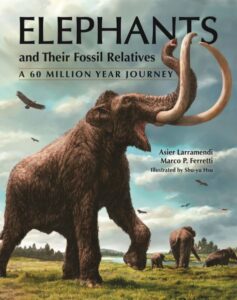
For those interested in discovering and learning about the truly remarkable evolutionary story of the Proboscideans, the new Elephants and Their Fossil Relatives: A 60 Million Year Journey by Asier Larramendi and Marco P. Ferretti is a book well worthy of note. Filled with detailed – yet still accessible to an interested amateur – explanations of the natural history, biology, and behavior of both ancient and modern species, and enlivened with the absolutely brilliant sometimes delightfully playful, illustrations of Shu-yu Hsu (my favourite is the human comparative example of a man in a business suit running alongside an enormous now extinct species), this huge (most appropriate, don’t you think?) new book is one all elephant enthusiasts should have on their respective library shelves (a particularly stout shelf – I wasn’t jesting when I wrote that it was huge).
If you enjoyed reading this, please consider signing up for The Well-read Naturalist's newsletter. You'll receive a helpful list of recently published reviews, short essays, and notes about books in your e-mail inbox once each fortnight.
