
 For an overwhelming majority of those who actively participate in the study of the natural world, the introduction to – and quite likely still their primary activity in – nature study was bird watching. It’s not difficult to understand why. Birds are commonly seen most everywhere people live and work, they are active (well, most of them, at least) during the same times when people are, they are colourful and do interesting things (flying, for example), and are of a size that requires no special equipment to observe and enjoy, although a binocular or similar small field optical instrument greatly enhances this enjoyment for most.
I myself have been a bird watcher for at least half my life to this point. Wherever I am, so long as I am out of doors or have a view to the outdoors, I’m usually at least casually keeping an eye out for birds. However many years ago I began to apply the observational skills I’ve learned as a bird watcher to other natural history activities. Butterflies and dragonflies are nearly as easily watched as are most birds, and in the summertime, bees are also common sights. And to be honest, I’ve often been given curious looks while having a prolonged look at a spider or beetle. And as it turns out, I’m not alone in doing such things.
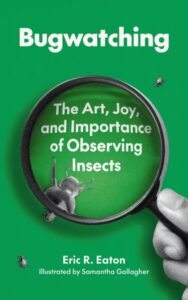
In his recently published Bugwatching; the Art, Joy, and Importance of Observing Insects, Eric R. Eaton presents his readers with a method for developing a practice of observing arthropods that is not dissimilar to that of watching birds. Being related to entomology in the way that bird watching is to ornithology, Mr. Eaton’s idea of bugwatching seeks to make the observation of insects and arachnids a popular past-time, or to borrow the delightful centuries old term coined by The Society of Friends for productive yet relaxing activities, rational recreation, by providing those interested with the information and techniques of practice to get them started along the path.
It is important to note, this is not the collecting of or pinning of insects as in more formal entomological studies, it is the observation of them in their natural habitats. Those familiar with the enormous number of species of insects and arachnids may at this time exclaim “But most of these creatures cannot be reliably identified in the field – that’s why they’re collected.” Mr. Eaton takes up that matter very effectively as well. I’ll have much more to write about this book in my forthcoming full-length review of it, but for now it is sufficient to stat that this is a book that is well worth your attention.
If you enjoyed reading this, please consider signing up for The Well-read Naturalist's newsletter. You'll receive a helpful list of recently published reviews, short essays, and notes about books in your e-mail inbox once each fortnight.
