
 Gin a body meet a body
Comin thro’ the rye,
Gin a body kiss a body —
Need a body cry “Ach, Fiona! Why are you now a purple elephant?!”
(With apologies to Robert Burns)
The relationship of ergot fungus to grasses such as rye that are cultivated and used by humans for food stretches back to the early medical writings of Mesopotamia, Greece, and China. Causing ergotism in humans, a condition that can produce a carnival of symptoms from unexplained buring sensations to severe hallucinations, ergot has also been recorded as having been used as early as the European middle ages in medical practice. And while ergot fungus does not itself contain lysergic acid diethylamide (LSD), it does contain a precursor for the synthesis of it, and as such is directly related to the research that developed it in the twentieth century.
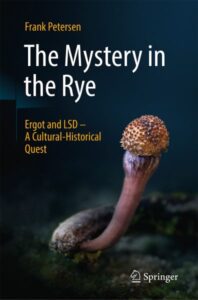
In The Mystery in the Rye; Ergot and LSD – A Cultural-Historical Quest, Prof. Dr. Frank Petersen presents a lively and eye-opening history of the ergot fungus and its relationship to medical research and pharmacology as well as to human – particularly popular – culture in the twentieth and twenty-first centuries.
As one who finds the history of medicine as well as the history of natural history to be of interest, I was delighted to see that someone had taken up the challenge of presenting the story of this long-known fungus in its multi-faceted relationships to both plants and humans in a manner that is quite accessible to a general but admittedly interested readership. While it is not a book that might be commonly found on general book store shelves, it is worth the effort to obtain a copy from Springer Naure directly, either in its hardcover or its digital editions, or check with your local library to discover if it can be borrowed from its collection or obtained via inter-library loan.
If you enjoyed reading this, please consider signing up for The Well-read Naturalist's newsletter. You'll receive a helpful list of recently published reviews, short essays, and notes about books in your e-mail inbox once each fortnight.
