
Growing up in the U.S. state of Oregon in the late nineteen sixties and nineteen seventies, I had more than ample opportunity and freedom to explore the outdoors. I took great advantage of both but usually did so alone. Being the only child of parents who fully embodied the meaning of “working” in working class, the only time I spent with my father in any manner of outdoor activity was when I was working beside him on our family’s small commercial fishing boat during the spring and autumn salmon runs on the lower Columbia River. He being born into a Finnish immigrant family, and my mother into a family perhaps best socially and economically describable as marginal and itinerant, they both learned early that anything they obtained in life would only come through their own hard work, and work hard they did – most every waking hour of every day.
Small and sickly with appallingly poor eyesight, I was not likely to succeed in the type of work done by my parents, so they taught me to read and write when I was very young, and not having even an average amount of formal education themselves, they subscribed to a set of World Book Encyclopedias for me, gave me a dictionary, and regularly encouraged me to use them to learn about anything I wanted to know. They also encouraged me to “go play outside.” I took both these lessons very much to heart, and from them I became interested in learning about the many interesting things to be found in the great outdoors.
The challenge in this was that spending time outdoors when young is only half the equation in learning about nature; having someone as a guide and a teacher who can help in learning what one was seeing, hearing, smelling, and yes, sometimes even tasting, is very important in developing further as an outdoorsman or a naturalist. Therefore when I became old enough to join the Boy Scouts – a group long famed for teaching boys about all things outdoors – I was three levels beyond eager and excited to do so.
To say that I loved being a Boy Scout is to understate the matter. It gave me a group to which to belong (something I had not previously had), opportunities to learn a great amount about a wide range of subjects and activities, and a system of visible recognition that was acknowledged and respected by the members of the group (unlike good school grades, which were only of interest to my teachers, my parents and myself). It also gave me a place that was safe from the bane of my childhood: bullying. Despite being bullied mercilessly and violently in school and in town for being unathletic, bookish, gentle, and polite, not once was I ever bullied among the Scouts. And, I might add, was it due to any complex, adult-directed anti-bullying program implemented by the organization; it was simply antithetical to the entire idea of the Boy Scouts and all the members knew it.
I never achieved my Eagle Scout award (the apex distinction awarded by the Boy Scouts of America at that time and that continues into the organization’s present existence as Scouting America); the struggles and pitfalls of teen-age life got in the way. Not having done so is something I count amongst my greatest regrets and most egregious personal failures. Nevertheless, I’ve since held those who did so in great respect, as I have long done the Scouting organization itself. Yet if I’m honest, and as a former Boy Scout I promised that I would be, I hadn’t really given the organization much thought for many a year beyond supporting their fundraisers when one of their members sought a donation.
Therefore when I noticed that Oxford University Press had this added the foundational book from which the entire Scouting Movement began, Robert Baden-Pawell’s 1908 Scouting for Boys; A Handbook for Instruction in Good Citizenship, to the Oxford World’s Classics series in January of 2025, it inspired in me a great amount of reflection upon my time in the Boy Scouts and what it meant to me. It also caused me to consider what it has now become and, naturally as a result, moved me to learn more about from whence it came.
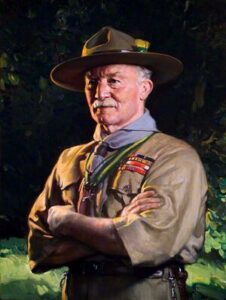
Originally published in May of 1908 as the collection of six installment-published booklets by Robert Baden-Powell – to give him full due honors and respect, Lieutenant-General Robert Stephenson Smyth Baden-Powell, 1st Baron Baden-Powell, OM, GCMG, GCVO, KCB, DL – from January to March of that same year, Scouting for Boys is both foundational to the Movement itself and to the scores of subsequent editions that continue to guide Scouts around to the world to this very day. Inspired by the use of his 1899 book Aids to Scouting (a work originally written in a military scouting context) having become both a best-selling book and increasingly one being used by teachers and youth groups, Ernest Thompson Seaton’s 1906 book The Birch-Bark Roll of the Woodcraft Indians, Lord Baden-Powell’s own experiences in the Second Boer War, particularly in regard to his actions during the siege of Mafeking that made him a British national hero, and his observations of life in early Twentieth Century Great Britan, he intended it to offer a collection of useful skills, motivational histories, inspiring ideas, and moral guidelines to the boys of his day that would help make them into better men for the good of themselves and that of the kingdom.
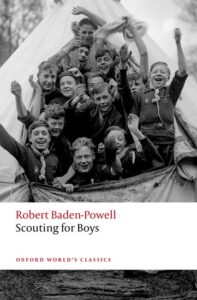 While an estimated one hundred fifty million copies Scouting for Boys and the many revisions to it that followed having now been sold, this new Oxford World Classic’s edition is the first critical edition to see print. Containing Lord Baden-Powell’s original 1908 text and illustrations, this new edition also includes an extensive historical and critical introduction by Prof. Elleke Boehmer that places the book in its time and gives the reader particularly valuable context for reading it today. It is also extensively annotated; something essential in a work such as this that includes so many references to daily life at the time of its composition as well as much else that would be outside the ready-to-hand knowledge of the average reader today and particularly helpful to those approaching it with a more analytical purpose in mind.
Now, at this time I must add, with much trepidation, that while I very much respect Prof. Boehmer’s extensive credentials as a scholar – she is, to give her full title and honors Prof. Elleke Boehmer, BA (Hons), MPhil (Oxon), DPhil (Oxon), FRSL FRHistS FEA, Professor of World Literature in English in the English Faculty, University of Oxford and Director of the Oxford Centre for Life-Writing (OCLW) and Professorial Governing Body Fellow at Wolfson College – beside which I stand as little more than Schmucky the book-reviewing clown, I did not always find her analysis through the lens of academic postcolonial literary theory helpful in my own reading of the book, nor did I agree with some of the psychological attributions, such as “imperialist angst,” she imparted to Lord Baden-Powell in her interpretations of some of his actions. Much if this is likely due to the differences between Prof. Boehmer’s postcolonial literary theory-based critical analysis of the book and the historical criticism that formed much of my own intellectual foundation. I don’t quibble with any of her factual historical accuracy in the contents of the introduction and notes for the book, but suffice it to state that Prof. Boehmer and I view the interpretation of the past from substantially different scholarly as well as social perspectives. However disagreements regarding the “inside baseball,” or “inside cricket” if you’d rather, scholarly differences regarding interpretation aside, I am very glad and deeply thankful for the clearly substantial work Prof. Boehmer put into bringing this critical edition of Scouting for Boys into print as part of the Oxford World’s Classic series as it will offer so many, such as myself, who were greatly influenced by the program of practical, ethical, and moral instruction it began an insight into the original thoughts and ideas about it of its founder.
To resume, having used the Scout Handbook (8th ed.) and then later the Official Boy Scout Handbook (9th ed.) – later editions of Ernest Thompson-Seaton’s 1911 published Handbook or Boys that was the first American edition written for the Boy Scouts of America formed on Lord Baden-Powell’s Scouting for Boys – during my own Boy Scout years, it was remarkable to discover just how much of the original Zeitgeist had endured. Foundational to Scouting for Boys is the idea that life cooped up indoors is not healthy – either physically or mentally. As Prof. Boehmer well explains in her introduction to this edition, a topic of great concern at the beginning of the Twentieth Century in Great Britain was the hardiness of British men. The Second Boer War had shown that over one third of men of eligible age were judged unfit for military service. Lord Baden-Powell repeatedly expounds upon this problem in the book, citing diminished average height and weight among British men of the time versus a century earlier. As a military man, he knew well the effect this could have upon the ability of the nation to defend itself – another topic of concern in Great Britain following this war.
Indeed, the Second Boer War (alternatively, Boer War, Boer War, Transvaal War, the Anglo–Boer War, or South African War, the Transvaal War, the Anglo–Boer War, or the South African War) was a particularly influential motivation for Lord Baden-Powell in the writing of the book. As previously mentioned, he had written and published a book on military scouting that had become a best seller by the time he returned to England from South Africa as a much-lauded hero for his leadership in the siege of Mafeking – which included, as Prof. Boehner explains, his drawing upon his life-long love of theater both to protect the town against attack by the larger besieging force and to help maintain morale among those trapped inside with him. This love of theater is also much in evidence throughout Scouting for Boys as staging plays is encouraged as a method of reinforcing historical and moral lessons taught in the book.
In addition to being the cause of the First World War being such a slaughterhouse due to the high ranking British officers having been junior officers during the Second Boer War and as a result clinging to the tactics of Nineteenth Century colonial wars instead of adapting to the ugly new realities of heavily mechanized Twentieth Century warfare, the Second Boer War was – much as was the American Civil War for the Union Army – a painful lesson in how effective irregular guerilla fighters who were accustomed to hunting, scouting, and fieldcraft could be against larger, better armed conventional army. Despite the overwhelming superiority in both size and equipment, the British suffered catastrophic losses of life and limb among their troops, and a war they had expected to be victoriously concluded in a few months lasted for years. After it finally ended, much attention was given by the British military, government officials, and the public at large to how much more successful they could have been if only their troops had been in better condition and better prepared.
Lord Baden-Powell admits in the last section of Scouting for Boys that he was already receiving criticism for the militarism he had included in the previously published sections when they were published serially. And indeed, such criticism has not gone away. Early on, entire organizations such as the predecessors to the Woodcraft Folk were established not so much in opposition to the Boy Scouts but more as alternatives to it that did not derive many of their ideas and activities from basic military training. However it should be noted that time and again in the book, Lord Baden-Powell unequivocally states his hatred of war and his belief that the training provided in the Scouts was to develop them as “peace scouts” well suited for service toward the betterment of a civilized society.
The activities in Scouting for Boys are overwhelmingly focused on physical activity and being outdoors. The games encouraged, skills taught, and habits recommended to be developed are those that lead a boy to spend time outdoors, either on the sports field or out in nature, and to know how to do so. Structured as it initially was on the idea of a patrol – a group of half a dozen or so boys – the activities both encourage and often require the boys to work together. It should be noted that upon publication of Scouting for Boys in serial sections, boys – and indeed groups of girls as well – self-organized themselves into such patrols well before any central organizational structure was established. There was clearly a public demand among British youth for what Lord Baden-Powell had to teach. As Sir Walter Scott famously wrote, “the hour’s come, and the man.”
As it was in my own time in the Boy Scouts, so in Scouting for Boys such skills as camping, first aid, land navigation and field cookery play a meaningful part, as do service to one’s community and society, and personal hygiene. However Scouting for Boys contains activities that came to be greatly lessened in later decades or eliminated entirely, such as training and practice in tracking and observing not just non-human animals but other people, as well as concealment and evasion. As a result, the reader comes to understand that both the noun and the verb “scout” are not randomly applied by Lord Baden-Powell to his work; he was unquestionably and enthusiastically teaching boys to be scouts in the truest, practical, and indeed martial senses of the words.
Of course, being an experienced and proficient scout as well as Scout has benefits to a wide range of activities. For Lord Baden-Powell, it not only would prepare boys to one day perhaps defend their nation in time of war, it would also prepare them to act as responsible citizens in time of peace, for to be a good scout required good health (one can’t track or evade if one is wheezing from smoking or drinking), good habits (being able to control oneself at all times is essential in scouting), good hygiene (for promotion of good health as well as for quick healing of injuries or illnesses), preparedness, perseverance, and dedication. It doesn’t take much imagination these same things are applicable to most all aspects of life, including, as they have for myself, the study of nature.
Given Lord Baden-Powell’s military background, his experiences therein, and the societal concerns of the day that were part of his inspiration for writing Scouting for Boys, it is not at all surprising that he includes a healthy amount of encouragement to love and service of Great Britain and – pace, my dear readers, pace – the British Empire. I will not undertake a justification or criticism of the included material on the latter in this essay as, for my part, it was simply a fact of life at that time and given his having often risked his own life in defense of it in many a battle I would not expect him to do other than stand by it, nor have I faced anything in my own life that would allow me to think myself justified in retroactively criticizing him for doing so. As to the former, I genuinely lament the loss of patriotism in my own nation. Growing up in the sixties and seventies, I had a ring-side seat at the tearing down of not only those in power but the very structure of the nation itself. Truth be told, I would like to believe in both the system of government of my country as well as those who serve in leadership of it. Alas, this has been greatly diminished in me by witnessing time and again during the course of my life the rise to power and abuse thereof by the unqualified, the self-serving, and the outright criminal. Lord Baden-Powell himself warned of this as one of the reasons for his desire to instill good citizenship in the those who would be Boy Scouts:
One form of bad citizenship among many is evident around us on the part of the people themselves, who, not having been taught to think of the future or of their country, allow themselves to come under the despotic power of a few professional agitators whose living depends on agitating […] (Scouting for Boys, 1908, Part VI)
This could have just as easily been written with as much truth today as it was then, and Lord Baden-Powell’s dedication throughout the book to overcome it through the encouragement to personal responsibility, self-control, dedication to self-improvement, and thinking of others before thinking of oneself is equally just as commendable as a method of overcoming it now as it was then.
I could easily continue at length, and indeed I fear I have already gone on far too long; therefore please allow me to conclude with a few simple observations. The entirety of Robert Baden-Powell’s Scouting for Boys can be well and thoroughly summarized in his own personal motto: Be Prepared. Nearly everything in the book points back to it as the guiding principle of the way of life he clearly hoped all those who read it would take to heart. It became the official motto of the Boy Scouts, was emblazoned on the scroll beneath the compass point Fleur-de-lis insignia I wore as a Scout, and is a guiding point of my life – when I’m at my best – to this very day, whether I’m always conscious of it or not.
Title: Scouting for Boys; A Handbook for Instruction in Good Citizenship
Author: Robert Baden-Powell
Series: Oxford World’s Classics
Format: Paperback
Pages: 448 pp., with117 black & white line drawings
ISBN: 9780198900344
Published: 05 January 2025
Nota bene:
In the U.S.A., the handbook used by Scouting America (the new name of what I knew as the Boy Scouts of America) has been split into two volumes as a result of the core entity of the overall organization becoming co-ed in 2018. These are:
- Scouts BSA Handbook (14th ed.): Handbook for Boys
- Scouts BSA Handbook (14th ed.): Handbook for Girls
The two volumes are largely identical with differences in imagery (the Boys volume depicting boys; the Girls volume girls) being the most notable. Both are filled with useful information and instruction about not only woodcraft, scout craft, and other outdoor subjects, but also cooking, nutrition, person hygiene, general first aid, and even staying safe from abuse and exploitation, and would serve well as handy essential skill reference guides for both young people and adults throughout their lives.
The Scouts in the U.K. no longer have a single comprehensive handbook.
If you enjoyed reading this, please consider signing up for The Well-read Naturalist's newsletter. You'll receive a helpful list of recently published reviews, short essays, and notes about books in your e-mail inbox once each fortnight.
