
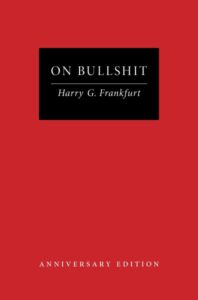
In his classic essay On Bullshit, the late and clearly great Dr. Harry G Frankfurt famously differentiated lying from bullshit in relation to the concern for the truth on the part of the person speaking or writing. Liars, he explained, must know and always keep the truth of the matter about which they are lying in mind as their purpose is to present something other than that truth to their audience. If they do not, they cannot hope to keep their lie consistent and their purpose will fail as a result.
Bullshitters, on the other hand, have no interest whatsoever in what the truth of the matter is as their only purpose is to impose their will on their audience. As a result, bullshitters can and do freely change what they say or write from one moment to the next as, being wholly disconnected from any reference to or interest in the truth, consistency is entirely irrelevant. A bullshitter’s only goal is to manipulate his or her audience to the intended purpose. Consequently, bullshit is far more insidious and dangerous than lies.
In our world today, whereas politicians were formerly not infrequently liars when it suited their needs, they are now more and more commonly bullshitters (I’m looking at you, Donald Trump). Influence peddlers, long known to be enthusiastic liars, have taken advantage of new mass communication platforms, shifted from lying to bullshitting, rebranded themselves as “influencers,” and as a result are more effective and are making more money than the wildest dreams of their occupational forebearers could have imagined. Thanks to Instagram, TikTok, and all the rest of the juvenile “social media” platforms, more and more people each day are having their understanding of very important matters – not only in regard to civil government, civic life, and economics but also medicine, science, and technology – befouled by bullshit.
Thus, with truth relegated to the wayside in the blind frenzied rush of so many down the road to what they believe is power and wealth, we live in a world increasingly buried in bullshit. Which is why it came to me as welcome news indeed that Princeton University Press is publishing a twentieth anniversary edition of Prof. Frankfurt’s 2005 essay On Bullshit, copies of which I dearly hope will find their ways into the hands of those still keeping their heads above the steaming piles rising all around us in order to provide them an eloquent, concise, and effective explanation of what bullshit is and how it works. Call me old fashioned, but even now, as I continually shovel my way to the surface each day, I still believe that knowledge is the best way to overcome falsehood, even bullshit.
Nota bene: or those interested in learning more about the origins of this essay, its publication as a book, Prof. Frankfurt’s work, and the dangers of bullshit, a very worthwhile interview of Prof. Pamela Hieronymi by Caleb Zakarin can be found at the New Books Network.
If you enjoyed reading this, please consider signing up for The Well-read Naturalist's newsletter. You'll receive a helpful list of recently published reviews, short essays, and notes about books in your e-mail inbox once each fortnight.
