
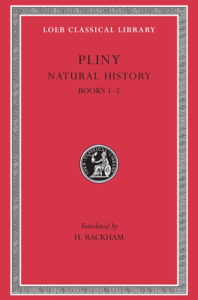
 As both a naturalist and a classicist, news of the sale by Harvard University Press on all of the volumes of the Loeb Classical Library was received by me with noticeable rejoicing and exclamations of great joy. Continuing through the end of June 2025, all Loeb volumes are offered at a 30% discount off the cover price when purchased from Harvard University Press’ website.
For those who might not be familiar with the Loeb Classical Library, it was founded in 1911 by James Loeb with, in the words of its own official history, “two goals in mind: first, to make the work of classical authors accessible to as many readers as possible—regardless of their knowledge of Greek or Latin—so they could profit from the wisdom of the ancients that had enriched his life so much; secondly, to offer the best of Anglo-American classical scholarship.” To this day it is and shows every sign of remaining as the only series devoted to the publication of ancient Greek and Latin literature in facing page original language and expertly translated English texts.
Now, I think I may hear some of you asking, “Well that’s all well and good to have volumes of ancient Greek and Latin works offered in such a sale, but what does that have to do with natural history?” A fair question indeed, in answer to which I would draw your attention to all the volumes of the series that take a topic of ancient natural philosophy, medicine, and mathematics at their subject:
- Aelian, On Animals, Volume I
- Aelian, On Animals, Volume II
- Aelian, On Animals, Volume III
- Aristotle, Generation of Animals
- Aristotle, History of Animals, Volume I
- Aristotle, History of Animals, Volume II
- Aristotle, History of Animals, Volume III
- Aristotle, Metaphysics, Volume I
- Aristotle, Metaphysics, Volume II
- Aristotle, Meteorologica
- Aristotle, Minor Works
- Aristotle, On the Heavens
- Aristotle, On the Soul. Parva Naturalia. On Breath
- Aristotle, Parts of Animals. Movement of Animals. Progression of Animals
- Aristotle, Physics, Volume I
- Aristotle, Physics, Volume II
- Cato and Varro, On Agriculture
- Celsus, On Medicine, Volume I
- Celsus, On Medicine, Volume II
- Celsus, On Medicine, Volume III
- Columella, On Agriculture, Volume I
- Columella, On Agriculture, Volume II
- Columella, On Agriculture, Volume III
- Galen, Hygiene, Volume I
- Galen, Hygiene, Volume II
- Galen, Method of Medicine, Volume I
- Galen, Method of Medicine, Volume II
- Galen, Method of Medicine, Volume III
- Galen, On Temperaments. On Non-Uniform Distemperment. The Soul’s Traits Depend on Bodily Temperament
- Galen, On the Constitution of the Art of Medicine. The Art of Medicine. A Method of Medicine to Glaucon
- Galen, On the Natural Faculties
- Greek Mathematical Works, Volume I: Thales to Euclid, Ivor Thomas, ed.
- Greek Mathematical Works, Volume II: Aristarchus to Pappus, Ivor Thomas, ed.
- Hippocrates, Affections. Diseases 1. Diseases 2
- Hippocrates, Coan Prenotions. Anatomical and Minor Clinical Writings
- Hippocrates, Diseases 3. Internal Affections. Regimen in Acute Diseases
- Hippocrates, Diseases of Women 1–2
- Hippocrates, Epidemics 2, 4-7
- Hippocrates, Generation. Nature of the Child. Diseases 4. Nature of Women and Barrenness
- Hippocrates, On Wounds in the Head. In the Surgery. On Fractures. On Joints. Mochlicon
- Hippocrates, Places in Man. Glands. Fleshes. Prorrhetic 1-2. Physician. Use of Liquids. Ulcers. Haemorrhoids and Fistulas
- Hippocrates, Prognostic. Regimen in Acute Diseases. The Sacred Disease. The Art. Breaths. Law. Decorum. Physician (Ch. 1). Dentition
- Hippocrates and Heracleitus, Nature of Man. Regimen in Health. Humours. Aphorisms. Regimen 1-3. Dreams. Heracleitus: On the Universe
- Lucretius, On the Nature of Things
- Manilius, Astronomica
- Plato, Timaeus. Critias. Cleitophon. Menexenus. Epistles
- Pliny, Natural History, Volume I: Books 1-2
- Pliny, Natural History, Volume II: Books 3-7
- Pliny, Natural History, Volume III: Books 8-11
- Pliny, Natural History, Volume IV: Books 12-16
- Pliny, Natural History, Volume V: Books 17-19
- Pliny, Natural History, Volume VI: Books 20-23
- Pliny, Natural History, Volume VII: Books 24-27
- Pliny, Natural History, Volume VIII: Books 28-32
- Pliny, Natural History, Volume IX: Books 33-35
- Pliny, Natural History, Volume X: Books 36-37
- Seneca, Natural Questions, Volume I
- Seneca, Natural Questions, Volume II
- Strabo, Geography, Volume I
- Strabo, Geography, Volume II
- Strabo, Geography, Volume III
- Strabo, Geography, Volume IV
- Strabo, Geography, Volume V
- Strabo, Geography, Volume VI
- Strabo, Geography, Volume VII
- Strabo, Geography, Volume VIII
- Theophrastus, De Causis Plantarum, Volume II: Books 3-4
- Theophrastus, De Causis Plantarum, Volume III: Books 5-6
- Theophrastus, Enquiry into Plants, Volume I: Books 1-5
- Theophrastus, Enquiry into Plants, Volume II: Books 6-9. On Odours. Weather Signs
There are volumes I could perhaps also include, such as those of Herodotus and Pausanius due to their not infrequent inclusions of matters pertaining to what one or another of their sources are recorded as having said or written on such subjects as those above, but I will leave them for the present and allow the list above to remain dedicated to those in which a subject of early scientific or mathematical interest is the primary purpose of the book.
If you enjoyed reading this, please consider signing up for The Well-read Naturalist's newsletter. You'll receive a helpful list of recently published reviews, short essays, and notes about books in your e-mail inbox once each fortnight.
